Seven days to launch. Forty-five to prove it.

Most startups die slowly.
Ours die on schedule.

Every product here starts with a problem someone already pays to avoid. It charges from the first week. If it isn't profitable by the deadline, it gets shut down — no exceptions, no sentiment. The ones that survive earned it in public.

Shipped

Three live. Three different reasons they work.

Not a roadmap. Each has its own domain, its own users and its own kill date. They share a studio and a clock — nothing else.

01

One Ask

For anyone looking for work

oneask.co

Looking for work, without announcing it to everyone you know.

LinkedIn made job-seeking public, which made it shameful. Here everyone is looking, so the stigma inverts. Your Circle is capped at thirty. One Ask every fourteen days. Four ways to answer, including a no that costs nothing to give.

Rules & structure · what we own

The rules are the product: thirty people, one Ask a fortnight, no read receipts, and a no that costs nothing to give. That's social design, not technology — no model release makes it obsolete.

02

Sanad

For Egyptians living abroad

getsanad.co

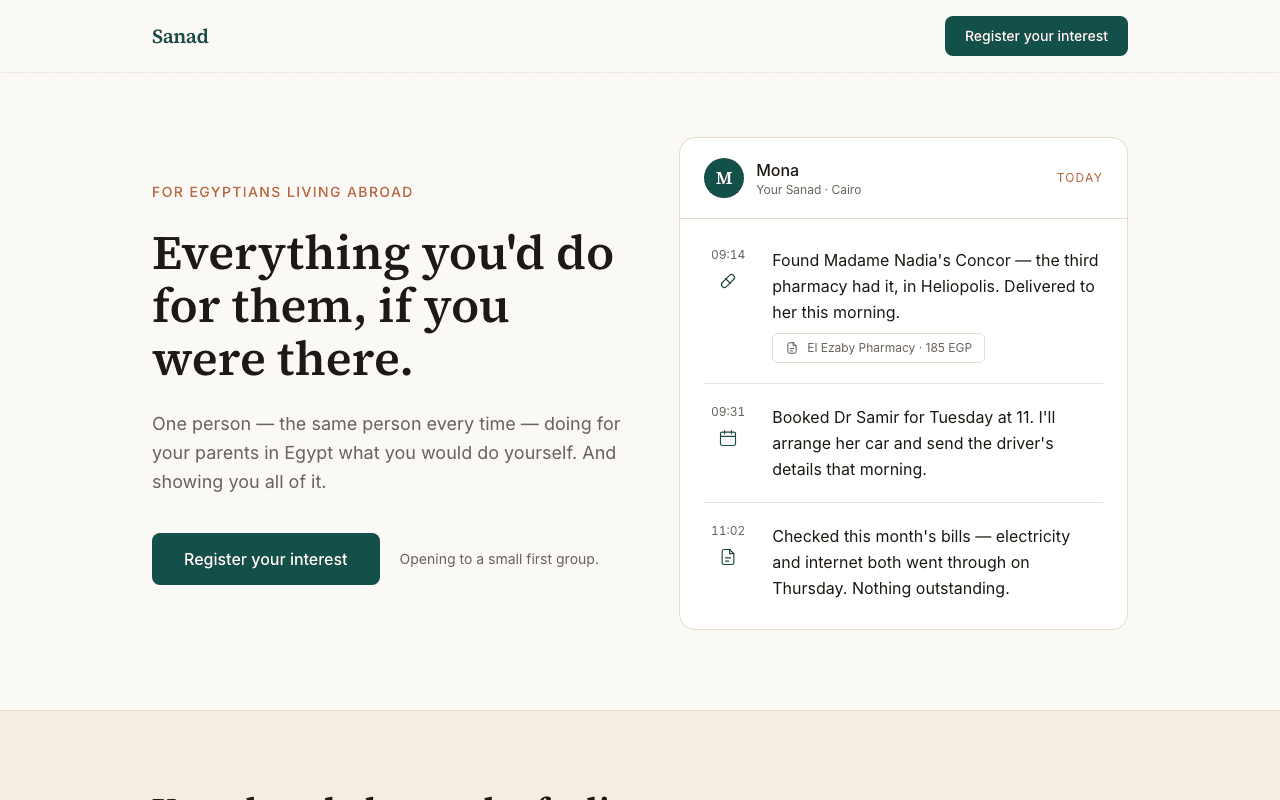
Everything you'd do for your parents, if you were there.

One named person in Egypt doing what you would do yourself. The prescription nobody has in stock. The renewal with a queue before dawn. The repair quoted at triple because they were on their own. Not a call centre — the same person every time, and every receipt reaches you unasked.

Services wave · what we own

Trust with a name on it. Software runs the dispatch and the reporting; the relationship is the moat, and it doesn't commoditize.

03

Shadow

For CTOs, product and engineering leaders

shadowahead.com

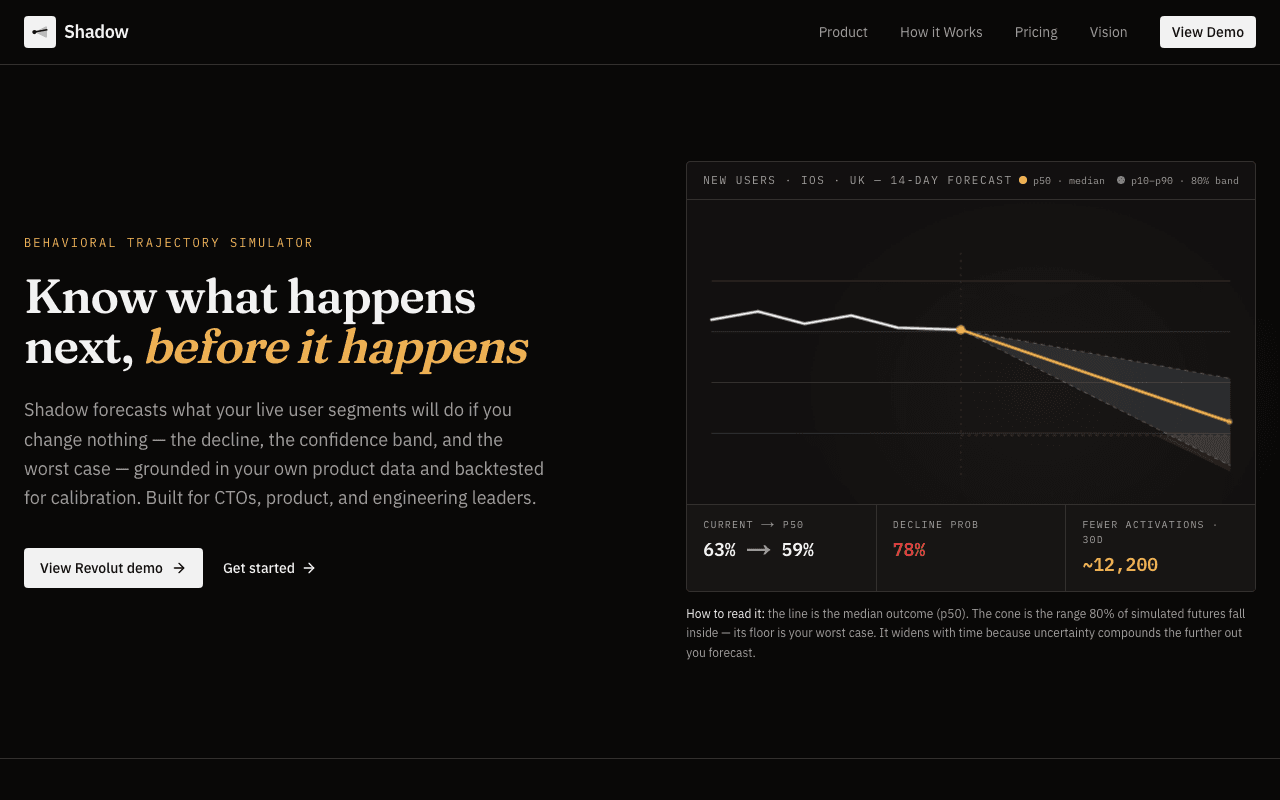
Know what happens next, before it happens.

Analytics explains the past. Shadow forecasts what your live segments do if you change nothing: 7, 14 and 30-day trajectories, an 80% band, and a realistic worst case, backtested on your own data. Read-only, no PII. Silent when it can't be sure.

Capability wave · what we own

Anyone can generate a forecast. Being provably calibrated on your data is the part you have to earn.

How we pick

Start with the problem. Everything else is negotiable.

No house style to defend, no stack to justify. Three rules decide what gets built.

The problem comes first

No technology in search of a use. Every product starts with a problem that already costs someone money, time or dignity. If we can't name who's paying and what it's costing them, we don't build it.

Named payer, or no build.

AI where it earns its place

Shadow only became possible once models got good enough. One Ask needed no model at all — it's a set of rules. Sanad is a person, coordinated by software. We use AI where it's the right answer, not where it's the fashionable one.

Solvable only once models got good enough. Wins on rules and structure, not capability.

Global by default, local by exception

Products launch worldwide on day one. When the problem is genuinely geographic, the product is local on purpose and says so — Sanad is not a global product and never will be. The exception has to be earned.

Geography is a product decision, not a limit.

The durability test

“What do we still own the day a foundation model ships this natively?”

Answer “nothing” and it's a feature, not a product. The durable layer is the workflow, the relationship or the network. Never the capability.

Operating model

We don't raise to survive. We build to earn.

The 7-45 rule is the whole governance layer. It replaces the roadmap, the steering committee and the expensive habit of keeping a dead product alive because stopping is awkward.

7days to launch
Version zero meets real users inside a week.
7days to revenue
If nobody pays by day seven, it wasn't four times better.
45days to profit or death
Kill criteria are written before the first line of code.

No capital needed to start

Every product reaches revenue on its own. That's what makes killing one cheap — nothing is being propped up to protect a round that was already spent.

Capital welcome once it compounds

When a product outgrows what lean can carry, outside money is the right tool. That's a conversation after traction, on one product at a time — not before it, and not for the studio.

Get in touch

What brings you here?

Use one of the products. Help build or sell one. Back one that's scaling. Bring distribution, or bring a problem worth solving. Say which, and you'll hear back within a couple of days.